Motor Bearing Life
If a motor drives a fan, pump, extruder, or textile machinery, etc. at a constant speed for a long time, the motor bearing life may rarely be shortened. This is a phenomenon called "bearing corrosion", which is caused by the current passing through the bearing. To prevent bearing corrosion, it is effective to install a zero phase reactor between the drive and motor or use a motor with an insulated bearing. Contact Yaskawa or your nearest sales representative for more information.
Low-Speed Range
When a drive operates a standard motor, it will lose more power compared to operating the motor with a commercial power supply. In the low speed range, the temperature of the motor increases quickly because the motor cannot decrease its temperature when the speed decreases. In these conditions, decrease the load torque of the motor in the low-speed range. Figure 1 shows the permitted load characteristics for a Yaskawa standard motor. When 100% continuous torque is necessary at low speeds, use a motor designed to operate with a drive.
Figure 1. Permitted Load Characteristics for a Yaskawa Standard Motors
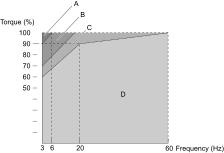
- 25% ED (or 15 min)
- 40% ED (or 20 min)
- 60% ED (or 40 min)
- Continuous operation
Insulation Withstand Voltage
Consider motor voltage tolerance levels and motor insulation in applications with an input voltage of over 440 V or particularly long wiring distances. Use an insulated drive motor.
| Notice |
|
Use an inverter-duty motor or vector-duty motor with reinforced insulation and windings applicable for use with an AC drive.
If the motor does not have the correct insulation, it can cause a short circuit or ground fault from insulation deterioration.
|
High-Speed Operation
If you operate a motor more than its rated speed, you can have problems with the motor bearing durability and dynamic balance of the machine. Contact the motor or machine manufacturer.
Torque Characteristics
When you operate a motor with a drive, the torque characteristics are different than when you operate the motor directly from line power. Make sure that you know about the load torque characteristics for your application.
Vibration
Vibrations could occur in the these conditions:
-
Resonance with the natural frequency of machinery
Use caution if you add a variable-speed drive to applications that operate the motor from line power at a constant speed. If resonance occurs, install shock-absorbing rubber around the base of the motor and enable the Jump frequency control.
-
The motor is not balanced
Use caution if the motor speed is more than the rated motor speed.
-
Subsynchronous resonance
Subsynchronous resonance can occur with long motor shafts and in applications such as turbines, blowers, and fans with high inertia loads.
Use Closed Loop Vector Control when these applications have subsynchronous resonance problems.
Audible Noise
The audible noise of the motor changes when the carrier frequency setting changes. When you use a high carrier frequency, audible noise from the motor is equivalent to the motor noise generated when you operate from line power. If you operate at speeds that are more than the rated rotation speed, the unwanted motor noise increases.